
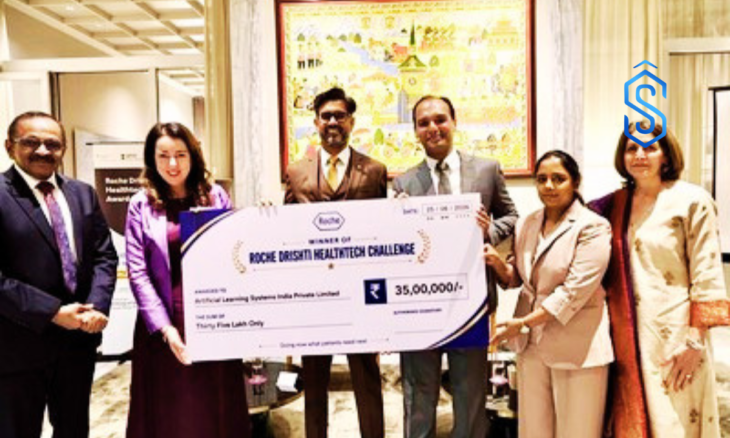
New Delhi: Healthcare startup Artelus, an AI-based provider of healthtech solutions focused on enhancing diagnosis and treatment outcomes, has emerged as the winner of the Roche Drishti HealthTech Challenge, a joint initiative by the Department for Promotion of Industry and Internal Trade (DPIIT) and Roche Pharma India under the Startup India programme.
The recognition highlights the growing contribution of homegrown healthtech innovators such as Artelus in transforming India’s healthcare ecosystem.
The Artelus victory came after the Drishti HealthTech Challenge received applications from more than 80 startups working across various digital health domains.
The initiative was designed to identify and support scalable and transformative healthtech solutions addressing some of India’s most pressing healthcare challenges.
The challenge focused on fostering innovation in retinal healthcare and digital health infrastructure. Applications were assessed by a distinguished jury comprising retinal health experts, startup mentors, and members of the Roche India leadership team.
The evaluation process involved a rigorous multi-stage assessment based on problem relevance, impact potential, market readiness, leadership credibility, and regulatory, legal, and intellectual property strengths.
Following this comprehensive process, Artelus was selected as the winner and will receive a financial grant of ₹35 lakhs to co-develop, enhance, and pilot its pioneering solution in partnership with Roche Pharma India.
The award ceremony was held at the Swiss Embassy in New Delhi in the presence of Her Excellency Mrs. Maya Tissafi, Ambassador of Switzerland to India and Bhutan.
The event marked another milestone in Indo-Swiss collaboration, driven by Roche’s partnership with Startup India and DPIIT to strengthen India’s healthcare ecosystem.
Also Read: India Startup Funding Jumps 218% to $1.06 Billion in June 19-25 Week: CRED Tops Deals
Maya Tissafi, Ambassador of Switzerland to India and Bhutan, said, “The Trade and Economic Partnership Agreement between EFTA and India has intensified the economic relationship between our countries.
It creates a ground for exactly the kind of innovation we see today – such as this initiative by Roche Pharma India and Startup India, which creates platforms for entrepreneurs and supports opportunities for collaboration and brings us closer to real-world impact.
I would like to offer special congratulations to the winning start-up, Artelus. Its work shows how healthtech can make early diagnosis more accessible and bring quality healthcare closer to those who need it.”
Ateesh Kumar Singh, Additional Secretary, DPIIT, said, “Fostering an ecosystem where advanced technology seamlessly integrates with grassroots healthcare delivery is key to sustainable economic development.
Initiatives like the Roche Drishti HealthTech Challenge underscore the immense potential of the Indian startup community to deliver high-impact solutions. Startup India, DPIIT remains committed to supporting open innovation frameworks that empower homegrown entrepreneurs to scale their impact across the country.”
Roche Pharma India Managing Director and CEO Rajji Mehdwan said, “Retinal diseases are stealing sight across India. The healthcare community has clinicians dedicated to helping people and the medicines that can truly make a difference. What we didn’t have was a way to make early diagnosis accessible to everyone.
Artelus solves that. Their offline AI technology brings screening to places we’ve never been able to reach before—expanding access to a much wider group of people. That changes everything. No patient should lose their vision to something preventable. Our partnership with DPIIT and Startup India reflects Roche’s unyielding commitment to India’s innovation ecosystem, nurturing local, home-grown solutions for India’s unique healthcare challenges.”
About the Winning Solution
Diabetic Retinopathy (DR) has emerged as a rapidly growing public health challenge in India, with delayed diagnosis often resulting in preventable blindness.
The Drishti HealthTech Challenge was launched to identify scalable, technology-driven solutions capable of addressing this gap.
Artelus won the challenge with its innovation, DRISTi (Diabetic Retinopathy Screening), an instantaneous CE Class 1 AI product designed to redefine point-of-care diagnostics.
Through its unique “AI on a Chip” technology, Artelus enables fully offline retinal screening without requiring internet or cloud connectivity.
Combined with backpack-friendly, 5G-enabled OCT systems, the solution aims to democratize healthcare by delivering comprehensive and transparent retinal diagnostics to remote regions across India.
Girish Somvanshi, Co-Founder and VP, Artelus, said, “Breakthrough therapies save vision only when patients access treatment in a timely manner.
The Roche Drishti Healthtech Challenge recognizes the critical importance of closing that gap. At Artelus, we are building the infrastructure to ensure every patient is identified, referred, treated, and followed up – at a population scale optimized for India and the rest of the world.”
About the Roche Drishti HealthTech Challenge
The Drishti HealthTech Challenge, launched on the Startup India platform, is a joint initiative by DPIIT and Roche aimed at strengthening India’s innovation ecosystem and advancing transformative healthcare solutions. The programme invited startups developing solutions in the areas of:
AI-driven early screening, referral, and treatment pathways for retinal diseases.
A unified, interoperable real-world evidence (RWE) platform capable of integrating with existing healthcare systems.
About Artelus
Artelus is an award-winning Indian healthtech company developing AI-powered portable diagnostics and digital health infrastructure for the early detection and integrated management of retinal diseases.
With a mission to make quality eye care accessible, affordable, and available globally, the company’s solutions are deployed across hospitals, public health programmes, NGOs, and international markets, helping reduce avoidable blindness at scale.